Best used for people who works from home. The ErgoQuest 500 lets you start working the minute you wake up from your sleep. Or even for MMORPG addicts who wants to save every minute of their life slashing away in some dungeon.
The ErgoQuest 500 is special height-adjustable computer desk which you can use while sitting, standing, or lying down. It can withstand up to 400lb (181kg) of weight, so your rig should be safe on it.
Got multi-monitors? They even carry optional LCD arms to hold two more LCDs for a triple monitor setup. Features list:
Work Surface: durable 1.5″ thick medium density board with black laminate and rubber-molded edge.
Keyboard tray and arm: Spring loaded sleeves adjust in width to accommodate a variety of keyboards. Mechanism has two pivot points, allowing the tray to tilt through 90 degrees and provide a range of positions for use in a reclined mode.
Power strip. Has 6 grounded outlets with a 12 foot grounded cord and plug. Strip can be mounted on either side.
Motorized legs: raise and lower table to and up to 400 lbs. of equipment from 31 to 50 degrees with the push of a button, for use in sit, stand, or recline position with minimal effort.
5″ Casters: Heavy-duty, ball bearing casters with elastomeric wheels to provide smooth movement. Front two casters are locking.
Keypad: provides push button controls of the motorized legs and monitor tilt platform.
Motorized monitor tilt platform: tilts monitors weighing up to 150 lbs. from 0 to 55 degrees for comfortable use in many positions including supine work. Also accommodates LCD monitors.
Cord management grommets: two 3″ diameter holes with plastic grommets provide power strip access below the tabletop.
Powder-Coated Steel Tube: The 2″ diameter steel tube frame eliminates a need for cross members beneath the work surface. They provide maximum clearance for recliners, beds and wheelchairs. Durable finish resists scratching.
The privilege of comfort doesn’t come cheaply. Each set is currently priced at US$3,695.
Monday, February 18, 2008
Best used for people who works from home


Sunday, February 17, 2008
101 gadgets that changed the world. whew!
1. Abacus, AD190
Use of the abacus, with its beads in a rack, was first documented in Han Dynasty China in about AD190, but the word dates to much earlier calculating devices. "Abacus" derives from the Hebrew ibeq, meaning to " wipe the dust" or from the Greek abax, meaning "board covered with dust", which describes the first devices used by the Babylonians. The Chinese version was the speediest way to do sums for centuries and, in the right hands, can still outpace electronic calculators.
2. Archimedes Screw, c.700BC
Purportedly devised by the ancient Greek physicist Archimedes of Syracuse in the 3rd century BC to expel bilge water from creaking ships, the screw that bears his name in fact predates Archimedes by about 400 years. Recent digs have established that earlier screws, which are capable of shifting water " uphill", were used in the Hanging Gardens of Babylon in the 7th century BC. So effective was the device, it is still used today in several sewage plants and irrigation ditches.
3. Aspirin, 1899
Little tablets of acetylsalicylic acid have probably cured more minor ills than any other medicine. Hippocrates was the first to realise the healing power of the substance – his related ancient Greek treatment was a tea made from willow bark, and was effective against fevers and gout. Much later, in turn-of-the-century Germany, chemist Felix Hoffman perfected the remedy on his arthritic father, marketing it under the trade name Aspirin.
4. Atari 2600, 1977
The gaming industry today is worth $30bn (£15bn) and new titles are released to more fanfare (and fervour among legions of gaming nuts) than the biggest Hollywood blockbusters (see Big Game Hunters, p37). Not so in the 1970s, when consoles were hard-wired to play one or two crude games such as Pong. Atari changed that with the 2600, the first console to take an unlimited number of games cartridges. The 1978 release of Space Invaders sent sluggish early sales skywards, heralding the age of the Wii, the PS3 and the Xbox 360.
5. Barbed wire, 1873
Symbol of oppression or a revolution in farming? It depends on which side of the fence you sit. Certainly, the world's most divisive invention was conceived not to keep people in or out, but cows. Joseph Gidden, a 60-year-old New Hampshire rancher was the first to invent a method for mass manufacturing of barbed wire and he made a fortune as miles of his wire criss-crossed American farms. Its low cost means it remains first choice for farmers and border guards.
6. Barcode, 1973
Barcodes were conceived as a kind of visual Morse code by a Philadelphia student in 1952, but retailers were slow to take up the technology, which could be unreliable. That changed in the early 1970s when the same student, Norman Woodland, then employed by IBM, devised the Universal Product Code. Since then, black stripes have appeared on almost everything we buy, a ubiquity fuelled by their price – it costs about a tenth of a penny to slap on a barcode.
7. Battery, 1800
For the battery we must thank the frog. In the 1780s, the Italian physicist Luigi Galvani discovered that a dead frog's leg would twitch when he touched it with two pieces of metal. Galvani had created a crude circuit and the phenomenon was taken up by his friend, the aristocratic Professor Alessandro Volta, whose voltaic cells stacked in a Voltaic pile amazed Napoleon. The pile was also the first battery, whose successors power more than a third of the gadgets on this list.
8. Bicycle, 1861
The renowned 19th-century US feminist Susan B Anthony said in an interview in 1896: "I think [the bicycle] has done more to emancipate women than anything else in the world." First devised as a gentleman's play thing in the 1820s, the push-powered hobby-horse quickly evolved to become the most classless form of transport, trundling by the millions along highways and byways all over the world. The French vélocipède, invented in 1861 by Pierre Marchaux, is widely considered to be the first true bicycle.
9. Biro, 1938
Had the Hungarian journalist Laszlo José Biró kept the patent for the world's first ballpoint pen, his estate (he died in 1985) would be worth billions. As it happened, Biró sold the patent to one Baron Bich of France in 1950. Biró's breakthrough had been to devise a ball-bearing nib capable of delivering to paper the smudge-resistant ink already used in printing. Today around 14 million Bic "Biros" are sold every day, perhaps making the pen the world's most successful gadget.
10. Blackberry, 1999
Ask the average office worker what he or she thinks of their Blackberry and they will variously call it (if they're not furiously tapping away at one) a boon and a curse. Developed by the Canadian firm Research in Motion and unleashed in 1999, the gizmo has provided legions of roaming desk jockeys with a hotline to their inboxes, and enabled armies of bosses to keep employees digitally shackled to their swivel chairs. The addictiveness of the device led it to be dubbed the "Crackberry".
11. Bow and arrow, 30,000BC
The major preoccupation for pre-historic man was killing whatever moved, and devising ever more efficient means to do it. For centuries hunters relied only on what missiles they had the strength to throw, breaking bones with sticks and stones. That changed somewhere in Africa, sometime more than 30,000 years ago, when the earliest archers emerged with bows and arrows. The earliest recovered weapons, dating from around 9,000BC, were unearthed near Hamburg and were made of pine tipped with flint.
12. Bra, 1913
Before she patented her creation, the New York socialite Mary Phelps Jacob, widely considered to be the inventor of the modern bra, had bought a sheer silk dress and devised a handkerchief and ribbon device as an alternative to unsightly corsets. She later sold her business for $1,500 to Warner Brothers Corset Company, who made $15m from her uplifting invention. Today, UK women spend £1.2bn on bras and pants each year; Marks & Spencer claims a market-leading 38 per cent share of sales.
13. Button, 1235
Which came first, the button or the buttonhole? The button; the ancient Greeks fastened tunics using crude buttons and loops, but it took the buttonhole to popularise the little discs of perforated plastic that adorn our clothes today. The earliest evidence comes from 13th-century German sculptures, which show tunics featuring six buttons running from neck to waist. Today, 60 per cent of the world's buttons are made in one Chinese town, Qiaotou, which churns out 15bn buttons a year (see also Zip).
14. Camcorder, 1983
It wasn't long ago that capturing moving images required a crew of grubby-handed technicians, yards of magnetic tape and a camera the size of a garden shed. These days, anyone can call themselves a film-maker. Sony was the first to produce a consumer camcorder with the release of its Betamovie in 1983.
15. Camera, 1826
The British polymath William Talbot, inventor of one of the earliest cameras (Joseph Nicéphore Niépce had produced the earliest surviving photograph on a pewter plate in 1826), was inspired by his inability to draw. He described one of his sketches as "melancholy to behold", wishing for a way to fix on paper the fleeting photographic images that had been observed for centuries using camera obscura. His early developing techniques in the late 1830s set the standard for decades – he invented the negative/positive process – and photography passed swiftly from novelty into ubiquity, helped in large part, in 1888, by George Eastman's Kodak, the first camera to take film.
16. Cardiac pacemaker, 1958
It wasn't long ago that if you had a terminally dodgy ticker you would be sent to hospital and hooked up to a large, static piece of kit. Cue Swedish doctors Rune Elmqvist and Ake Senning, who in 1958 designed the first implantable pacemaker. Their device failed within hours and it took the US engineer Wilson Greatbatch to build a reliable model in his garden shed. He tested a prototype on a dog in 1958 and, in 1960, Henry Hannafield, 77, became the first human recipient.
17. CD, 1965
For the US inventor James Russell, the crackly sound of vinyl ruined music, so he patented a disc that could be read with a laser rather than a needle. Philips and Sony picked up the trail in the early 1970s, when they perfected the Compact Audio Disc or CAD, later shortened to CD. The first discs appeared in shops in the early 1980s and could play 74 minutes, on the insistence of Sony chief Akio Morita, who stipulated one disc could carry Beethoven's Ninth Symphony.
18. Clockwork radio, 1991
With the wind-up radio, not only did deprived areas of the developing world get access to public information about Aids and contraception, but we were gifted a true legend of invention. Trevor Bayliss (see My Secret Life, p7), a former professional swimmer, stuntman and pool salesman, devised the contraption after being horrified by reports from Africa that safe-sex education wasn't getting through.
19. Compass, 1190
Forced to rely on natural cues such as cliffs or spits of land, as well as crude maps and the heavens, early mariners would get hopelessly lost. Desperate for something more reliable, sailors in China and Europe independently discovered in the 12th century lodestone, a magnetic mineral that aligned with the North Pole. By 1190, Italian navigators were using lodestone to magnetise needles floating in bowls of water. The device set humanity on the course to chart the globe.
20. Condom, 1640
Egyptians donned them 3,000 years ago and the 16th-century Italian gynaecologist Gabriele Falloppio (he of the tubes) first advocated their use to prevent the spread of disease. The earliest remains of a condom, which date from 1640, were discovered in Dudley. In modern times, condoms, which until the 1960s were made from animal gut, have allowed generations of couples to avoid unwanted pregnancies and saved an inestimable number of lives by preventing the spread of diseases such as Aids.
21. Credit card, 1950
Before the advent of "plastic", consumers were forced to queue at bureaux de change and high-street banks to get their hands on cash. Today millions of us (there are 66 million credit cards in circulation in the UK – six million more than there are people) can get our hands on anything with just a swipe of a card, whether we can afford it or not (outstanding credit stands at about £60bn). We have the American Ralph Schneider, founder of the Diners' Club card, to thank for this dangerous convenience.
22. Digital camera, 1975
There could be no digital camera without the charge-coupled device (CCD), the "digital film" that captures images electronically. Developed in 1969, the widget allowed the Kodak engineer Steven Sasson to build the first digital camera, which resembled a toaster. The first, horribly blurry snap (of a female lab assistant) he took boasted just 0.01 megapixels and took almost a minute to record and display, but in those 60 seconds, Sasson had transformed photography – today digital cameras have all but killed off film and made photographers of us all.
23. Digital TV recorder, 1999
In homes full of slimmed-down TVs and gleaming DVD players, video cassettes, with their clunky heads and jam-prone magnetic tape, look decidedly dated and are a more common site at car boot sales than on living-room shelves. That is thanks, in part, to the rise of the digital recorder, which (almost) silently lays down programmes on a computer hard disk. The first consumer systems came from ReplayTV and TiVo, and have been joined in the UK by Sky+, as well as cable and Freeview hard-disk recorders.
24. Digital watch, 1972
Watches made the short journey from bosom to wrist during the 19th century, due in part to the craze among middle-class women for cycling. Their new, more convenient position made sense and they developed quickly. Rolex made the first waterproof watch in 1926 and a year later the ultra-accurate quartz-crystal controlled clock arrived. Watches finally went digital in the 1970s when the Hamilton Company developed the Pulsar, which sported lights in place of hands; the liquid crystal display (LCD) followed in 1977.
25. Drum, 12,000BC
It's a mystery as to what made man first knock on a bone or a gourd with no other intention than to make a nice noise, but thank goodness he did – it is hard to imagine a world without music. Evidence of music-making dates back tens of thousands of years, but it is thought the drum was the first instrument to be built, possibly as early as 12,000BC. The earliest tuneable instrument, the stringed harp, was first plucked in modern-day Iraq in around 4,500BC.
26. Dynamite, 1867
Few inventions, save perhaps the atomic bomb, can claim to have shaken the world in quite the same way as nitroglycerine. And few inventions can have claimed so many lives. The first to succumb to the explosive force of Dynamite was the inventor's brother; Alfred Nobel's youngest sibling perished when an early experiment to stabilise nitroglycerine by adding a chalky material called kieselguhr, went horribly wrong. In 1896, Nobel used his Dynamite fortune to endow the Nobel Prizes.
27. Electric shaver, 1928
For sensitive-skinned men who daily face the choice between tearing their cheeks to shreds or growing a scraggly beard, the electric razor is a godsend. They can thank a retired American soldier for the invention. While working in Alaskan mines before returning to service in the First World War, Lieutenant Colonel Jacob Schick struggled with foam and blades in the sub-zero temperatures. His prototype electric alternative resembled modern razors, but it was attached to a bulky external motor: self-contained shavers appeared in 1928.
28. Eraser, 1770
Strange, perhaps, that it took 200 years after the invention of the lead pencil for somebody to dream up the eraser. Until then, draughtsman had to use bread, but the English engineer Edward Naine saw potential in natural rubber to do a better job. It did, but, like bread, was perishable. The advent of more durable vulcanised rubber in 1839 (a method pioneered by the tyre tycoon Charles Goodyear) sealed the future of the eraser. Hymen Lipman conceived the all-in-one pencil eraser in 1858.
29. Fax machine, 1843
A young person today might struggle to pick a fax machine out of a line-up of obsolete office gadgets, but most desk jockeys still familiar with the device probably don't realise it is more than 160 years old. Yes, they didn't have digital displays and printouts that say "OK", but the device built by the Scottish clockmaker Alexander Bain in 1843, which comprised a pen attached to a pendulum kept in motion by electromagnetic impulses, is remarkably similar in principle to the modern machine.
30. Fibre optic cable, 1966
In an experiment requiring nothing more complicated than two buckets, a tap and some water, the Irish scientist John Tyndall in 1870 observed that a flow of water could channel sunlight. Fibre optics – tubes of glass or plastic capable of transmitting signals much more efficiently than traditional metal wire – operate under the same principles and were perfected by Charles Kao and George Hockham in 1966. Today, thousands of miles of cables link all corners of the globe.
31. Fire, 590,000BC
Fire, like air or water, is nothing new – but the ability to control it is. Well, quite new. Evidence suggests early man used fire more than a million years ago, but the earliest signs that we had learned to command it date from nearly 800,000 years ago. Archaeologists at a dig in Israel in 2004 discovered clusters of burnt flint tools, evidence of hearths or campfires. The ability to start fire in a flash only came with the invention of the match in 1827 (see Match).
32. Fish hook, 30,000BC
It isn't a complicated device, the fish hook – just a bit of bent wire with a sharpened end – but throughout most of human history it has allowed man to nab a meal without risking life and limb hunting wild animals, or busting a gut in the fields. The earliest hooks, which probably date to around 30,000BC, were in fact carved in wood. Others have been fashioned from horns, shells, thorns or even, in the case of the Easter Islands, the thigh bones of deceased fishermen.
33. Floppy disk, 1971
They may seem horribly dated today (many modern computers don't even ship with floppy disk drives) but for more than 20 years – aeons in the digital age – they were the only effective means to carry data between computers. The first floppies, invented in 1971 by IBM geek Alan Shugart, held just 100 kilobytes; modern disks can store 1.44 megabytes. Today, the largest iPod can store the same amount of data as 113,778 floppy disks, which in a stack, would match the height of London's BT Tower.
34. Flushing toilet, 1597
Thomas Crapper, right? Wrong. Sir John Harrington, author, courtier and godson to Queen Elizabeth I, is the true inventor of the flush toilet. The miscredited Crapper, whose name helped build the urban myth that has surrounded him for centuries, indeed had a hand in toilets, but Harrington beat him to it, installing lavatories for the Queen at Richmond in the late 16th century. The "Crapper" (the world crap existed long before Thomas) was improved with the invention of the "S" bend in 1775.
35. Fridge, 1834
The greatest kitchen convenience was the death of the greengrocer, allowing harried professionals to keep perishables "fresh" for days at a time. But few people (greengrocers aside) would bemoan their invention. Jacob Perkins was the first to describe how pipes filled with volatile chemicals whose molecules evaporated very easily could keep food cool, like wind chilling your skin after a dip in the sea. But he neglected to publish his invention and its evolution was slow – fridges would not be commonplace for another 100 years.
36. Gore-Tex, 1972
Hard to believe that, in 1924, Edmund Hillary set off for Everest wearing a tweed jacket and plus fours. Whether or not he reached the summit, chances are he would have kept a whole lot warmer with the help of Gore-Tex. Robert Gore started a career in innovation with insulated electrical wire but made his name by creating a breathable yet waterproof fabric (its key feature being an incredible 1.4bn pores per square inch, each 20,000 times smaller than a water droplet).
37. GPS, 1978
Determining your location used to require such cumbersome devices as a map, compass and ruler. Now a single press of a button (and up to 32 satellites) will pinpoint your precise position to within a couple of metres. Great for explorers, paramedics and pilots – not so good for unwitting Latvian lorry drivers sent on cross-country wild goose chases by budget sat-navs. Developed by the US military in the 1970s, the Global Positioning System has been globally available since 1994.
38. Guillotine, 1792
It is surely one of the greatest ironies that the inventor of the most efficient machines of execution was a campaigner against the death penalty. Until such a ban could be passed, the French physician and penal reformer, Joseph Ignace Guillotin, proposed the device as a swift and relatively " humane" alternative to public quartering or beheading by blunt axe. But it stuck; the guillotine was used in France for the last time in 1977 and remained the only legal method of execution until Paris finally abolished the death penalty in 1981.
39. Gun, 14th century
It seems that black powder, as gunpowder was originally called, emerged in 11th-century China as a medicine, but it was the mixture's explosive properties that sparked interest in Europe. It led to the creation of the cannon in the 13th century, which transformed warfare, greatly boosting the force of mediaeval armies. One of the biggest steps on the road to the modern gun was Smith and Wesson's metal-cased cartridge, first fired in 1857.
40. Internal combustion engine, 1859
It may have fallen firmly out of favour in today's green-aware world, but the importance of the internal combustion engine is impossible to overstate. Without it, we could not drive, fly, travel by train, build factories, motor across oceans, trim our lawns ... the list is endless. Credit for the first working internal combustion engine goes to the Belgian inventor Étienne Lenoir, who converted a steam engine in 1859. It boasted just one horsepower and was woefully inefficient, but spawned the billions of engines that have been built since.
41. iPod, 2001
Can it really be just six years since the now ubiquitous slab of sleek white plastic and polished steel burst on to the gadget scene and helped to revolutionise the music industry? Conceived by Apple's British design luminary, Jonathan Ive, the iPod, the largest of which can store more than 30,000 songs, has sold an astonishing 110m units in 14 incarnations (that's an average 2,000 iPods an hour).
42. Kettle, 1891
In tea-obsessed Britain, where would we be without the humble kettle? It has been said that the kitchen-counter staple is found in more homes than any other appliance. Non-electric kettles date back thousands of years but would leave you waiting ages for your brew. The first electric kettle was developed in Chicago in 1891 but even that took 12 minutes to boil water. Things soon got quicker and today's speediest kettles can boil two cups in little over a minute.
43. Laptop, 1982
A sturdy lap was required to support the earliest portable computers. The Osborne 1, released in 1981, often stakes a claim as the first laptop but it looked more like a sewing machine than today's sleek machines, and tipped the scales at more than 10kg. Introduced a year later, the GriD Compass 1100, designed by Brit Bill Moggridge, is a more likely contender. It was the first laptop to sport the now standard "clamshell" case and its lightweight build (5kg) made it a hit with Nasa and US paratroopers.
44. Laser, 1960
Laser, as any quiz night regular will know, stands for Light Amplification by Stimulated Emission of Radiation. It was Albert Einstein who laid the foundations for its development, when in 1917 he said atoms could be stimulated to emit photons in a single direction. The phenomenon was first observed in the 1950s and the physicist Theodore Maiman built the first working laser in 1960. His device was based around a ruby crystal that emitted light "brighter than the centre of the sun".
45. Lawnmower, 1830
Back in the old days only the very wealthy could afford to pay teams of scythe-wielding labourers to keep their pristine lawns in check (or get sheep to do the job, and put up with with droppings between the toes). A farmer's son and textile mill labourer called Edwin Budding changed that in 1830, when, inspired by rotary machines used to trim velvet, he joined forces with the businessman John Ferrabee to build a self-powered cylinder mower almost identical to those still in use.
46. Lead pencil, 1564
Any schoolboy worth his salt knows pencils do not in fact contain potentially poisonous lead. And they never did; the pencil arrived with the discovery in 1564 in Borrowdale, Cumbria, of a pure deposit of graphite, then thought to be a type of lead. A year later, the German naturalist Conrad Gesner described a wooden writing tool that contained the substance. Nicolas Conté perfected the pencil more than a century later by mixing graphite with clay and gluing it between two strips of wood.
47. Light bulb, 1848
So new-fangled was the light bulb in the 19th century, it came with a warning: "This room is equipped with Edison Electric Light. Do not attempt to light with match. Simply turn key on wall by the door. The use of electricity for lighting is in no way detrimental to health, nor does it effect the soundness of sleep." Joseph Swan in fact developed a bulb before Edison, but the pair later joined forces and share credit for creating the gadget we perhaps take for granted more than any other.
48. Locks, 2000BC
Listen to the jangle of the average set of keys and it's clear just how important security has become in today's trust-nobody world. The Egyptians were the first to put things under lock and key about 4,000 years ago (clever knots were one earlier solution). The wooden contraption included a key that lifted pins, allowing a latch bar to slide free. The device was similar in principle to the pin-tumbler lock invented in 1848 by Linus Yale, whose name still adorns billions of keys.
49. Machine gun, 1884
Hiram Maxim, the London-based American man who invented the world's first totally automatic machine gun, was supposedly inspired by an American friend, who said the route to riches was to "invent something that will enable these Europeans to cut each other's throats with greater facility" . It worked: Maxim's brutally efficient gun was adopted by several armies and its successors inflicted horrific casualties in the First World War. Displaying an apparent penchant for deadly devices, Maxim also invented the only slightly less destructive common mousetrap.
50. Mechanical clock, 1092
The time on the earliest clocks could be heard and not seen, indeed the word "clock" comes from the Latin clocca (bell). The most elaborate early examples date to 11th-century China, when a monk described a water-powered time keeping device. The first known public clock appeared on the Viscount of Milan's palace in 1335. The big revolution in clock design came with the introduction of the pendulum in the 17th century, allowing everyone from traders to farmers and military commanders to know precisely what the time was.
51. Microchip, 1958
It is impossible to sum up how much these tiny slivers of silicon and metal have transformed our lives. They feature in everything from toys to tanks and motorbikes to microwaves but when, in 1952, the engineer Geoffrey Dummer proposed using a block of silicon, whose layers would provide the components of electronic systems, nobody took him seriously and he never built a working prototype. Six years later, US engineer Jack Kilby took the baton and built the world's first monolithic integrated circuit, or microchip.
52. Microscope, 1590
When the British polymath Robert Hooke published his 1665 masterpiece, Micrographia, people were blown away by its depictions of the miniature world. Samuel Pepys called it "the most ingenious book that I ever read in my life". Until then, few people knew that fleas had hairy legs or that plants comprised cells (Hooke coined the term "cell"). Zacharias Janssen, a Dutch spectacle maker, had invented the first microscope in 1590, although it was then regarded as a novelty rather than a revolution in science.
53. Microwave oven, 1946
The first victim of the microwave was a peanut bar. It had been in the pocket of American engineer Dr Percy Spencer, who was working in range of the radio waves emitted by a magnetron, a key component in radar. It melted, so an intrigued Spencer applied the magnetron to an egg, which exploded. By the end of the year, the first prototype had been built and commercial ovens (costing £30,000 in today's money) soon followed, eventually producing dodgy dinners by the million.
54. Mobile phone, 1947
There are more than two billion mobile phones in the world, and the EU is home to more "cells", as the American's call them, than people. It is difficult to quantify the economic and social impact of the device – of all the gadgets in the average person's arsenal, it is surely the one we would be worst off without. Those who disagree can blame Bell Laboratories for their invention; the firm introduced the first service in Missouri in 1947. Widespread coverage in Britain did not begin until the late 1980s.
55. Mouse, 1964
Early computers were the size of houses and sported a bewildering array of buttons and sliders. With the explosion in the amount of information pinging across screens around the world, a simple way to manage it all was required. The US radar technician Douglas Engelbart of the Stanford Research Institute took up the challenge and produced the first "X-Y position indicator" prototype in 1964. Its tail-like cable lead to the mouse moniker, and their population is expected to top a billion by the end of next year.
56. Nintendo Gameboy, 1989
On its release in the late 1980s, the Gameboy was surely the most coveted piece of kit in the playground, but dig one out of the attic today and its two-tone grey face and titchy screen give few clues to its extraordinary success. Many companies would try to better it but none could come close to toppling the Gameboy, and its stable of killer games, including Tetris and Super Mario Land, as the best-selling gaming system of all time (worldwide sales reached well over 100m).
57. Noise-cancelling headphones, 1988
So they haven't cured pandemics or furthered man's understanding of the universe, but for airline passengers allergic to the sound of crying babies or easily distracted office workers, headphones that block out the ambient din are a life-saver. The story goes that, on a flight to Europe, Amar Bose, the billionaire founder of the Bose audio equipment firm, was so unimpressed with the complementary pair of cans, he set about making a pair that could generate sound waves to neutralise incoming noise.
58. Paper clip, c.1892
The simplicity of the paperclip made it an instant hit – an example of that rare marriage of aesthetics and function. Bent-wire clips cropped up in American offices as early as 1867 but it was the British-designed Gem paper clip, which was never patented, that took off and is still produced by the billion (18bn a year in the US). An 1894 advert for the clips read, " Don't mutilate your papers with pins or fasteners, but use the Gem Paper Clip."
59. Paper, AD105
Modern means of communication have only slightly diminished our dependence on paper, but for 500 years its existence remained secret. The Chinese began using bark, bamboo fibres, hemp and flax to mill the first reams almost 2,000 years ago, but it took centuries for paper to envelop the world, first taking in Japan, then Central Asia and Egypt. Until then, writers could still write, but the parchment, vellum or silk used by early scribes was prohibitively expensive.
60. PC, 1977
The computers IBM were producing for businesses as early as the late 1950s cost about $100,000 (almost £500,000 today), so the idea of one in every home remained a dream. But that changed in the 1970s when a group of chip-wielding geeks based in California began tinkering in garages. One of the brightest techies operating in what is now dubbed Silicon Valley was Steve Jobs, whose Apple II, launched in 1977, was the first consumer PC to resemble the machines that went on to transform our lives.
61. Plough, AD100
Means to turn over soil are as old as agriculture – the first farmers in the Middle East used tree branches or roots to grub up fields – but when farming spread to the heavier ground of northern Europe, a more sturdy solution was required. The carruca, which comprised a blade to dig the earth and a mouldboard to turn over the furrow, set the principles for the early heavy plough and, pulled by oxen or horses, contributed, eventually, to the agricultural revolution.
62. Pneumatic tyre, 1845
Back when cars relied on real horse-power and bicycles weighed a ton, travellers were forced to endure bone-jarring rides over the bumps and potholes of the nation's primitive roads. Cue Robert Thomson, a civil engineer who realised the potential of air to soften the way. In 1845, he patented the use of pneumatic leather tyres on bikes. In 1888, a Scottish vet called John Dunlop devised the more durable rubber inner-tube model that helped inflate the age of the automobile.
63. Pocket calculator, 1971
Even the legendary superbrain Isaac Newton was known to complain about the time it took to do simple sums on paper. He would have been delighted by the introduction in 1948 of the Curta calculator, a hand-cranked, barrel-shaped calculator small enough to fit in the pocket and capable of basic calculations. The first slimline digital pocket calculator was the Sinclair Executive, which cost about three times the average weekly wage but set the standard.
64. Polaroid camera, 1947
Edwin Land probably did not predict his photographic innovation would one day allow a generation of couples to take naughty pictures without fear of exposure at the developer's. He was inspired by his daughter, Jennifer, who asked why she had to wait so long to see her holiday snaps. He unveiled the Land Camera in 1947, and the first instant camera became popular with police officers and artists (and those naughty couples – one luxury hotel in Mexico provides a Polaroid camera in every room).
65. Pop-up toaster, 1926
Toast is nothing new – the Romans held bread over flames to prolong its edible life – but it took convenience-obsessed America to come up with a contraption that would do it for us. In 1926, the Toastmaster popped into general stores, but it took another 18 years for the wedding present favourite to land in the UK, where Morphy-Richards introduced the first model in 1948. Last year Americans bought 12.3m toasters.
66. Post-it note, 1973
The scourge of office cleaners and the obsession of list freaks, Post-It notes have peeled out of the factory of US manufacturing giant, 3M, in their billions since their serendipitous invention nearly 35 years ago. It was a 3M designer called Art Fry who, frustrated by errant hymnbook page markers at choir practice, realised the need for a low-tack sticky note. He applied a weak glue to yellow paper and the Post-It, now sold in more than 100 countries and in 62 colours, was born.
67. Printing press, 1454
For the large part of modern civilisation, the written word reigned supreme as the only means of communication. The Chinese were the world's first printers – they practised block printing as early as 500 AD – but a German goldsmith called Johannes Gutenberg was the first to construct a press that comprised moveable metal type, which, when laid over ink, could print repeatedly on to paper. In 1454 he used the revolutionary system to print 300 bibles, of which 48 copies survive, each worth millions of pounds.
68. Qwerty keyboard, 1868
Little surprise that the idea for a practical typing machine capable of churning out pages faster than the speediest pen-wielding copytaker was born in the offices of a newspaper. The journalist Christopher Latham Sholes of the Milwaukee News devised the first typewriter, but its alphabetical layout meant common letters in close proximity frequently jammed at high typing speeds. To minimise such clashing, Sholes conceived the Qwerty layout, which outlived mechanical keyboards.
69. Radio, 1895
We were nearly denied radio by an uncharacteristic lack of foresight shown by one Heinrich Hertz who, while demonstrating electromagnetic waves in 1888, told his students, "I don't see any useful purpose for this mysterious, invisible electromagnetic energy." Fortunately, Alexander Popov, a Russian, and the Italian-Irish inventor Guglielmo Marconi, saw the potential in the technology and separately sent and received the first radio waves. Marconi sent the first transatlantic radio message (three dots for the letter "S") in 1901.
70. Robot, 1921
The term robot dates to 1921, when the Czech playwright Karel Capek referred to put-upon serfs as "robots" in his play R.U.R (Rossum's Universal Robots). Eventually they cause unemployment and lead to the collapse of society. That hasn't happened yet in the real world, but nearly 90 years since Capek's vision, the rise of the robot has gathered pace as a gallery of droids and autonomous machines walks, crawls and rolls out of robotics labs around the world, able to do anything from building cars to performing brain surgery.
71. Rubber band, 1845
Debate about the origins of the humble rubber band stretches back centuries, but the likeliest candidate for its conception is thought to be one Stephen Perry of the London-based rubber manufacturing company Messers Perry and Co. He patented the invention in 1845 to hold papers or envelopes together. Their manufacture (sleeves of vulcanised rubber are chopped into bands) and function has changed little since. Today, Royal Mail gets through 342 million red rubber bands a year.
72. Saddle, AD200
The horse had almost joined the woolly mammoth and the T. rex on the list of extinct species when man first domesticated it in around 4,000BC. The beast's fortunes quickly changed and the horse soon became man's most useful (if not best) friend. Early ranchers and riders rode bareback or on blankets, limiting the efficiency with which they could hunt. These rattled horsemen had to wait until AD200 to get their bums on a saddle, which is thought to have been invented by Chinese nomads.
73. Safety razor, 1895
Generations of sore-faced inventors struggled to make a razor blade for shaving that was lethally sharp yet safe, until one man came up with the solution. King Camp Gillette of America, possessor of the greatest name in the history of innovation, devised in the 1890s the world's first razor fitted with disposable blades mounted in safety housing. The system made him a fortune – by 1903 he had sold 12 million blades. In 2005, Procter & Gamble bought Gillette for $57bn.
74. Sellotape, 1937
The earliest reference to sticky tape turns up in a 17th-century book about music, which describes how lute makers used "little pieces of Paper, so big as pence or two pences, wet with Glew" to help make their instruments. But it wasn't until the 1930s that Colin Kininmonth and George Gray, inspired by a French patent, coated Cellophane film with a natural rubber resin. They came up with the name Sellotape, and it stuck.
75. Sewing machine, 1830
Humans had used bone and horn to sew for tens of thousands of years, but the first patent for a machine that could do it without the need for such cumbersome devices as pins and thimbles was submitted in 1790. It didn't work. The first functioning machine was invented by Frenchman Barthélemy Thimonnier in 1830, but his machines were destroyed in riots. In 1845, Elias Howe built the contraption that would spawn the modern day machine, including those built by one Isaac Merritt Singer.
76. SMS, 1992
Linguist purists H8 txtspk. The Short Message Service (SMS) has developed the thumbs of a generation of communicators who have devised their own shorthand, textspeak, to stay in touch (and uncover extra-marital affairs). The British engineer Neil Papworth sent the first (unabbreviated) text 15 years ago. It read: "MERRY CHRISTMAS". Their popularity exploded in the late 1990s and now in the UK alone we send millions every day (a record 214 million last New Year's Eve).
77. Spectacles, 1451
The correcting qualities of stone have been known for millennia – Emperor Nero was thought to use emerald to watch (presumably green-tinted) gladiatorial games. Modern glasses were first depicted in a 1352 portrait of Hugh de Provence, and the first evidence of their sale dates to 1450s Florence. The US founding father Benjamin Franklin is credited with the invention of bifocals in 1784 and useable contact lenses followed in 1887. Today, an estimated 75 per cent of UK adults sports a pair of specs.
78. Stethoscope, 1819
You would think in this age of electron microscopes and robot surgeons that a bit of rubber tubing attached to headphones and a diaphragm would have joined the head mirror and the cauterising iron in the graveyard of medical innovation. But so simple and effective is the stethoscope that the sight of one slung about the shoulders of a white coated doctor remains as familiar as ever. The flamboyantly monikered Frenchman, René Théophile Hyacinthe Laënnec, invented the first device that amplified the sounds of the human body.
79. Swiss Army Knife, 1897
Every camper's favourite multitool was originally called the Offiziersmesser (officer's knife) but that was a bit of a mouthful for the American soldiers who popularised it outside its landlocked birthplace, so they called it the Swiss Army Knife. It originated in Schwyz, Switzerland, more than a 100 years ago, after a surgical equipment manufacturer was dismayed to learn Germany supplied the Swiss army with knives. The company he founded, Victorinox, still supplies Swiss soldiers and makes 5.5 million knives a year.
80. Syringe, 1844
Syringe devices have been in use since the 9th century, when an Egyptian surgeon used a glass suction tube to remove cataracts from a patient, but the first hypodermic syringes with needles fine enough to pierce skin did not appear until the 1840s. The Irish physician Francis Rynd used the first syringe to inject a sedative to treat neuralgia, revolutionising medicine with a single push of a plunger.
81. Telephone, 1876
Frenchman Charles Bourseul first proposed transmitting speech electronically in 1854, but he was ahead of his time and it took another six years before Johann Reis used a cork, knitting needle, sausage skin and a piece of platinum to transmit sound, if not intelligible speech (that took another 16 years). Elisha Gray and Alexander Graham Bell raced to make the first working phone in the 1870s, Bell winning in a photo-finish. Today there are 1.3 billion phone lines in use around the world.
82. Telescope, 1608
Galileo was the inventor of the word "telescope", but not the instrument. That distinction goes to the two Dutchmen who inspired him, Hans Lipperhey and Zacharias Jansen. They were the first to combine convex and concave lenses at either end of a wooden tube, a device Galileo later touted as a military aid, before turning his attention to the stars. Early telescopes could magnify up to only 20 times; today even the amateur astronomer can pick up a telescope with 500x magnification for as little as £40.
83. Television, 1925
Without it there would be no Celebrity Love Island, no Extraordinary Breastfeeding (Channel 4, 2006), no Chantelle. OK, so it hasn't all been bad – television has helped connect people around the world, entertained billions, and kept generations of children occupied on lazy Sunday mornings. Not that CP Scott, editor of the Manchester Guardian, was impressed. He said in 1920: "Television? The word is half Greek and half Latin. No good will come of it." Scotsman John Logie Baird first demonstrated TV to the public in 1925.
84. The internet, 1969
The simplest way to illustrate the inestimable impact of the internet is to chart the growth in the number of people connected to it: from just four in 1969 to 50,000 in 1988; a million by 1991 and 500 million by 2001. And today - 1.2 billion, or 19 per cent of the world's population. Conceived by the US Department of Defense in the 1960s, the internet, together with the World Wide Web, invented in 1989 by Brit techie, Tim Berners-Lee, has shrunk the world like no other invention.
85. The match, 1826
The Stockholm-based chemist John Walker was the first to make the striking discovery that when a stick coated in potassium chlorate and antimony sulphide was brushed across stone, it created a flame. For the first time, man could make fire quickly, cleanly and safely, be it against a rock, a doorframe or the jaw of a bestubbled cowboy. A succession of chemists perfected Walker's mix and in the 1850s, a Swedish scientist split the chemicals between the match and the striking surface, creating the safety match.
86. The Pill, 1951
The contraceptive pill not only empowered women, but marked a turning point in medicine – it was the first drug used by "healthy" people to prevent something rather than by the sick to treat an ailment. It was developed by a team headed by Carl Djerassi, a chemist, in 1951, but wasn't marketed in the UK until 1962. Since then, more than 300 million women are thought to have used the Pill; in the UK, an estimated three million women use it each year.
87. Thermometer, 1592
It is difficult to place the thermometer in the history of modern invention; it is one of those devices that would inevitably appear – the product of no single mind. Galileo Galilei is most commonly credited, but his clumsy air thermometer, in which a column of air trapped in water expanded when warmed, was the culmination of more than 100 years of improvement. The classic mercury-in-glass thermometer, still in use today, was conceived by Daniel Fahrenheit in the 1720s.
88. Tools, 2,600,000BC
If there is one defining feature of Homo that has separated it from all other genera, it is the ability to make tools. The earliest tool fragments come from East Africa and were made by Homo habilis more than two million years ago, but it is certain early man used tools before then, likely fashioning them from perishable materials such as wood or bone. Axes emerged as early as 10,000BC and by 3000BC the Egyptians were creating finely worked flints.
89. Toothbrush, 1498
For millennia people have used a fantastic array of implements to keep their pearly whites brilliant. Frayed twigs, chewing sticks, birds' feathers and porcupine quills; all have been discovered in the excavated remains of the earliest bathrooms. An unknown Chinese was the first, at the turn of the 15th century, to mount bristles at right angles to a handle – the spines were plucked from hogs and set into bamboo or bone. By the 17th century toothbrushes were widely used in Europe.
90. Transistor radio, 1953
Pottering around the garden to the sounds of the Ashes; lying back in the bath with The Archers on; blocking out the office din with a chart hit; all simple pleasures made possible by the transistor radio. Until their introduction, radios were bulky affairs hooked up to the mains, but that changed in the early 1950s when the transistor manufacturer Texas Instruments commissioned the Indianapolis firm IDEA to develop the Regency TR1, which cost almost £300 in today's money when it went on sale in 1954.
91. Transistor, 1947
We have all heard the word and probably know that it's something to do with electronics, but how many of us realise the importance of the transistor, possibly the most unsung gadget in the history of invention? Barely the size of a finger nail and resembling a tiny insect, the little widget is the fundamental building block of the circuitry in computers, mobile phones, and practically every other electronic device we take for granted. They were invented at the Bell Telephone Laboratories in 1947.
92. TV remote control, 1950
It is no surprise that the first remote control, made by the US company Zenith Electronics, was quickly nicknamed "Lazybones". The device, originally linked to the television by an unsightly wire, enabled generations of channel hopping couch potatoes to sit back and zap. In 1955, Zenith released the first wireless remote, the "Flashmatic", which spawned the family of remotes that now crowds the average coffee table. Universal remotes, made by One For All, followed in 1987.
93. Umbrella, 2400BC
Named after the Latin umbra, meaning shade, the umbrella started life in Mesopotamia as a sunshade. Rain-proof brolleys made of treated paper popped up in China about 1,700 years ago and had become a French fashion accessory by the 17th century. But not for men – it took London man-about-town Joseph Hanway, who was rarely seen without a brolley, to make it socially acceptable for chaps to be seen with one. The Sheffield manufacturer Samuel Fox invented the modern steel-ribbed umbrella in 1852.
94. Vacuum cleaner, 1901
Cumbersome contraptions that required the user to crank a handle while pushing them along the floor were sucking up dust in the US as early as the 1860s. The first powered vacuum cleaner arrived in 1901 but Hubert Booth's huge device relied on a five horse-power engine. The American cleaner James Spangler refined the vacuum in 1908 with the introduction of a pillow case to collect dust. He sold the rights to a saddle and leather company by the name of Hoover. The rest, along with dust in millions of homes around the world, is history.
95. Velcro, 1948
The Swiss inventor George de Mestral became so fed up with removing cocklebur seeds from his dog and jacket, he put one under a microscope to discover the secret of its stickiness. The answer: velours (the French for loops, in clothing) and crochets (hooks, on the burs). He took the first syllables of the words, replicated the fastening phenomenon synthetically to create Velcro, used today in everything from ski jackets to "human Velcro walls".
96. VHS recorder, 1976
For more than 30 years after TV broadcasting as we know it appeared in the 1930s, viewers were forced to cancel dates and delay dinners if they wanted to catch the latest episode of Coronation Street (well, the Coronation of King George VI, anyway). Video recording in fact dates back to 1927, when John Logie Baird used wax discs, but it wasn't until JVC won the video format war with Sony that its VHS format became the standard, bringing the power to record into every home.
97. Vibrator, 1902
They may not have shaken the world, but for generations of women, a fantastically diverse gallery of powered dildos has caused the earth to move. In a 2005 global survey, 26 per cent of women admitted to using a vibrator (47 per cent in Taiwan; 3 per cent in India; but presumably none in Alabama, where vibrators are banned) and today "massage" devices can be purchased, discretely, with the click of a mouse. Things were different in the 1890s, when "vulvular stimulation" was prescribed to treat "female hysteria".
98. Walkman, 1979
Today we take music on the move for granted – naturalists have even speculated that future iPod generations will evolve headphone jacks where our tails used to sprout. Well, not really, but most of today's music listeners will not remember a time when mobile music meant groaning under the weight of a ghettoblaster. Sony came up with the first popular personal stereo cassette player, although the German-Brazilian Andreas Pavel had patented a similar device called the Stereobelt in 1978. The Walkman was commissioned by the firm's opera-loving chief, Akio Morita (see CD), who wanted to access all arias on plane flights.
99. Weighing scales, 5000BC
For most of us, weighing scales appear only from beneath the bath to deliver bad news or collect dust at the back of the kitchen cupboard, but their invention stands as one of modern civilisation's most important achievements. Thought to have been conceived, in the form of a crude equal-arm balance, in Egypt in around 5000BC, weighing scales facilitated early trade – the first balances were used to weigh gold dust. The Egyptians also invented the first unit of weight – the kite – in around 3000BC.
100. Wheel, 3500BC
The wheel surely deserves a place near the top of any "greatest inventions" list; a post-industrial world without it is inconceivable. Its invention was perhaps inevitable, but it came later than it might have done; several civilisations, including the Incas and the Aztecs did pretty well without wheels. The earliest evidence of a wheel – a pictograph from Sumeria (modern day Iraq) – dates from 3500BC; the device rolled West soon after that.
101. Zip, 1913
Look at your flies or your handbag and, chances are, the zip that keeps your valuables in place started life in a factory in the Qiaotou, a dusty town in Zhejiang Province, China. Qiaotou's zip plants manufacture an astonishing 80 per cent of the world's zips, churning out 124,000 miles of zip each year (enough to stretch five times round the globe or half way to the moon). Credit for the device's invention goes to Gideon Sundback. In 1913, the Swedish engineer made the first modern zip to fasten high boots.
Monday, February 11, 2008
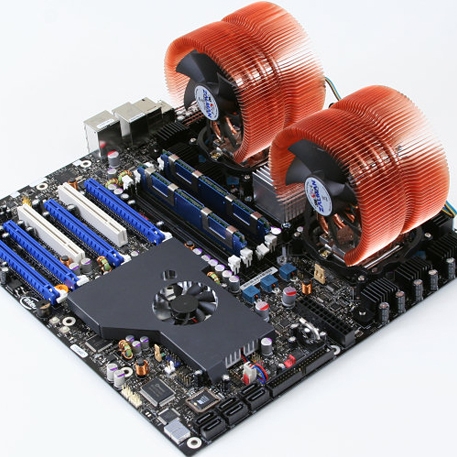
Intel's Dual-CPU Beast: Skulltrail Finally Gets Detailed
The Xeon platform, although extremely powerful and overclockable, has been kept off the consumers' hands for 10 years now. It was about time that Intel released a consumer-oriented alternative based on the powerful Xeons, and the 10th Xeon anniversary will bring us the Skulltrail beast in all its splendor.
Skulltrail is a strange kind of platform, comprised of an Intel D5400XS motherboard and a pair of LGA771
quad-core Xeons that have undergone some significant tweaks. The manufacturer had them rebranded as Core 2 Extreme QX9775, since the Xeon name would make the user associate it with those expensive servers.
The Skulltrail platform basically inherits all the important aspects of the Xeon technology, but at the same time, they are different in some key points. The Xeon X5482s are fully interchangeable with the Core 2 Extreme QX9775 chips and are based on the same socket LGA 771, rather than the usual LGA775 for desktop systems. Moreover, both processors have the same four cores running at 3.2GHz, 12MB of L2 cache (6MB divided per two cores) and a 400MHz (1,600MHz effective) front side bus.
At the same time, while the Xeons are optimized for pre-fetching workstation/server applications such as database functionality, the QX9775 are tweaked for gaming and multimedia computing. Moreover, the Core 2 Extreme name shows that the processor comes with an unlocked multiplier, that comes in handy for those who are planning to overclock a lot. Based on the Penryn 45-nanometer architecture, both Xeon X5482 and Core 2 Extreme QX9775 CPUs are energy-efficient and feature low thermal envelopes.
The Intel D5400XS motherboard is built around the Intel 5400 chipset that also powers new Xeon motherboards (such as the SuperMicro X7DAW-N, for instance). The bad thing about this chipset is that you will be forced to feed it the expensive and slower 800MHz PC2-6400 FBDIMM memory, since DDR2 or DDR3 modules are not supported.
The good side is that the D5400XS is extremely expandable. It provides four 16x PCI-E 1.1 slots and two PCI slots. The chipset is also fully compatible with the PCI-Express 2.0 standard, but Intel rigged the four graphics expansion slots with Nvidia's nForce 100 chips, the cornerstone of the SLI technology. CrossFire is also supported, so it's up to you whether you pick Nvidia or AMD to power your display(s).
The board's PCB has been reshaped in order to allow enthusiasts use LGA 775 cooling solutions, since the LGA 771 offering is extremely poor and cheap. The fans, however, must be positioned in a way that would allow them to blow cold air over both FBDIMMs and the Northbridge.
The motherboard also comes with RAID-capable S-ATA II ports, plus a pair of eSATA ports that allows users to connect external storage devices. The board also features 10 USB 2.0 ports, two FireWire connectors and a single EIDE port for older optical drives.
Thursday, February 7, 2008
Microsoft bids $44.6 billion for Yahoo

Microsoft went public Friday with a $44.6 billion cash-and-stock bid to acquire Yahoo.
In its response, Yahoo called the Microsoft bid "unsolicited" but did not reject it.
Microsoft's offer, which was contained in the letter to Yahoo's board, amounts to $31 a share and represents a 62 percent premium over Yahoo's closing price on Thursday. Microsoft said it will offer shareholders the option of cash or stock.
"We have great respect for Yahoo, and together, we can offer an increasingly exciting set of solutions for consumers, publishers, and advertisers while becoming better positioned to compete in the online-services market," Microsoft CEO Steve Ballmer said in a statement.
Make His Valentine’s Day Fantasy Come to Life
For many women, Valentine’s Day is all about getting chocolates, flowers, and being wined and dined. But truthfully, men don’t care about any of that. While he will appreciate any thought that you put into your Valentine’s Day, men just have different ways of being swept off their feet.
Men are all about being intimate on Valentine’s Day. While this can often mean that it will end up in the bedroom, it doesn’t always have to. Something as simple as just playing a sexy game can be enough to rev his engine. There are many of these games that can be purchased, or you can make one of your own. To make one, simply cut out red hearts on construction paper. Then place cute and sexy instructions on each heart. These sayings should give instructions such as, “Kiss your partner in a place you never have before.” It can be a lot of fun to find places that you’ve never kissed each other before and it can play out as one of his biggest fantasies because you each have to do what the instructions say. The advantage of making the hearts yourself is you can make it as naughty or nice as you want.
Another great way to add fun into his fantasy is to do some preparation before he arrives at your door. Turn all of the lights down and place candles everywhere. Place a CD player somewhere near the door with a giant note on it (so he can’t miss it) that says, “Play me first and then follow the clues.” When he turns on the CD player, it will start to play slow, romantic music. Place a bottle of chilled champagne somewhere near the player and write another note on it that says, “Open me when you’re ready and find the next clue.” Place a sexy bra outside of the bedroom door with a note on this that says, “Are you ready now?” When he opens the bedroom door, he will find you ready to fill his Valentine’s Day fantasies.
Another simple way to make his fantasies come to life on Valentine’s Day is to simply ask him what his fantasies are. Maybe he’s always wanted someone to dress up for him as a certain character or figure (think naughty nurse costume), or maybe he’s always wanted to see what it’s like to play with handcuffs. It could even be something as simple as giving each other a head-to-toe massage with great smelling (or edible!) massage oils. Ask him about a week before Valentine’s Day so that you can be fully prepared to fulfill his fantasy on the big day!
If you take the time to understand what is he wants on Valentine’s Day, he will not only be knocked off his feet by how great his Valentine’s Day was, he will be touched that you went to the time and trouble to think about what he wants and making his Valentine’s Day fantasies come to life!
Saturday, February 2, 2008
Web 2.0 cage match: Microsoft vs. Yahoo

The potential merger of Microsoft and Yahoo will put the two companies' Web apps in internal conflict. In some cases, a Microsoft app might replace a Yahoo app. But in more cases, products from Yahoo, a company built for the online platform, will be the ones to survive. Here are likely outcomes from what would surely become a multiyear internal struggle.
Portals and start pages: Yahoo.com vs. MSN.com
Portal pages like My Yahoo and MSN.com, and their personal page counterparts My Yahoo and My MSN, act as big advertisements to whatever products and media the company wants to push on a given day. Yahoo and MSN will likely keep their distinct brands for a good long time while the underlying platforms and user bases are merged. On the surface, the products themselves are more alike than different. But online content and indexing is Yahoo's main business; it will pick up this battle. Winner: Yahoo.
Search: Search.yahoo.com vs. Live.com
Yahoo, founded on Internet search, has three times the search market share of Microsoft. Microsoft will kill its good-money-after-bad Web search project and move its users over to Yahoo. Winner: Yahoo.
Email: Yahoo Mail vs. Hotmail
I give the nod to the killer development team over at Yahoo, which came over in the OddPostWinner: Yahoo. acquisition. While most of those people are now on other Yahoo projects, the OddPost platform is slick and innovative. Microsoft could slowly move its users over.
Mapping: Yahoo Local Maps vs. Live Search Maps
Microsoft has the pretty bird's eye view and a 3D map viewer plug-in (which is cool but slow on many machines). But Yahoo has a better fundamental mapping product that allows click-and-drag rerouting. Google Maps is still more useful than both. Winner: a merger, hopefully, of Microsoft's features with Yahoo's nicer UI.
Photo sharing. Flickr vs. Live Spaces
Even though I think Flickr is too weird for the real world and that Yahoo should not have killed its straightforward and smooth Yahoo Photos, Microsoft buries its photo site in its blogging platform, Live Spaces. It's a nice tool but the content and the users have hewn to Flickr, due to its community-forward features like group tags and its open API. Winner: Yahoo.
Bookmarking: Delicious vs. Listas
Ever heard of Listas? Exactly. Winner: Yahoo. (Actually, Microsoft has money in Digg, but it doesn't own it.)
Microsoft-Yahoo: What Will Stay And What Will Go?

Here’s some upcoming clashes and which side/ service may continue into the future.
MSN vs Yahoo (front page)

Conclusion: MSN to be sold or wound down in favor of Yahoo and (Windows) Live.
MSN International vs Yahoo International
Outside of the United States gets more interesting as both Yahoo and Microsoft have co-ownership agreements in many international markets, for example Yahoo7 vs Ninemsn in Australia. Many of the existing partners are also commercial rivals in respective markets, causing issues for a combined Microsoft-Yahoo maintaining all existing partnerships. There may also be competition concerns in some markets as well.
Conclusion: Existing partnerships to be divested or shut internationally, with a slant towards maintaining Yahoo’s deals.
Account Management: Yahoo ID vs Live ID
Merging two different ID systems will be interesting, but not impossible. Microsoft and Yahoo already offer country specific and occasionally service specific ID’s. Both have moved towards implementing OpenID.
Conclusion: a new unified ID system that will work across all properties in the combined entity with existing ID’s and also OpenID as well.
Personalized Home Page: My Yahoo vs Live
Yahoo will remain, but the bigger question is exactly what Microsoft will do with Live. The brand won’t disappear, but we may see it used in different ways, possibly even as Yahoo Live or similar. The personalized Live product maybe on borrowed time.
Conclusion: My Yahoo to stay, possibly Live powered by Yahoo.
Yahoo Search vs Live Search
Another hard one, but definitely as space where two will end up as one. Yahoo’s search product has never been a strong point, and Microsoft has pumped a lot of money into Live. A combined unit that keeps the best talent from both may finally come close to creating a Google killer.
Conclusion: Live Search to replace Yahoo Search on Yahoo.
Search Advertising: Yahoo Search Marketing vs Microsoft AdCenter
Microsoft has aggressively landed sites such as Facebook and Digg for its ads, where as Yahoo squandered its opportunity with Panama. Neither platform is perfect, but on the balance Microsoft AdCenter will become the one platform across the combined company, with YPN to be integrated into that.
Conclusion: Microsoft adCenter will win the day
Some quick ones:
Games (Yahoo vs MSN): Yahoo games has the longest history and will continue to be maintained within the Yahoo portal.
IM: combined client that supports both, and other IM platforms. Branding could be interesting here as it could go either way…or perhaps maintain both.
Mapping: Microsoft. Live Maps will be provided by the Yahoo portal, giving a leg up to what (particularly in 3D) is a market leading product in terms of tech that not enough people know about
Mail: interesting due to Microsoft’s tie-in with Outlook/ Windows, and the desire to maintain a Windows look. It probably should go to Yahoo, but I think on something as big as email Microsoft will win the day in terms of the platform used to unify both. Various email addresses (like hotmail before it) to continue to work
Q&A: Yahoo Answers to win the day, and I’m betting most people didn’t know Microsoft had a service like this, but they do.
Photo-sharing: Flickr is the obvious answer, but photo-sharing is a key battleground with Google. It depends on what Microsoft does with its Live branded downloads, but I’ll bet on a Flickr Live photo management tool for Windows that replicates Picasa.
Widgets: Microsoft, if only because Microsoft widgets come pre-installed with Vista. Yahoo Widgets possibly sold off; it would seem to be a waste to kill them off.
And super-quick: Mobile: Yahoo, Website services: Yahoo/ Geocities, Blogging: Live, Social Bookmarking: De.licio.us, Events: Upcoming, Music Service: Zune Marketplace (with some implementation onto Yahoo itself), Music Software: WMP (given), Mashup Tools: Popfly.
There are even more services than this, if you’d like to add any, or give your opinion on one service over another, feel free to do so in the comments.
Read the rest of this entry »News Corp. Scrambles To Bid For Yahoo
The rumors keep on rolling around the surprise semi-hostile Microsoft bid for Yahoo this morning. Sillicon Alley Insider says they’ve heard that a couple of hedge funds were already preparing their own bids for Yahoo, and were (or perhaps still are) days away from making their move.
According to our source, other big private equity funds were busy today, too. Taking calls from News Corp., that is.
News Corp. and Yahoo have been mulling over a merger (of Yahoo and MySpace) since the middle of last year. But the deal back then had News Corp. selling off MySpace in exchange for 25% of Yahoo’s stock. Now the roles have been reversed. Today, News Corp. was supposedly making calls to put together a syndicate and make a counter offer to what Microsoft put on the table. No takers so far, we hear.
All of this is likely to come to nothing, though. I agree with Paul Kedrosky and Mathew Ingram - Microsoft has probably already won this deal, simply because they aren’t relying solely on spreadsheets in their valuation. Hedge funds don’t have that luxury.
MicroHoo: The effect on search and Web services

Just about everyone else on the Internet has written on the potential acquisition of Yahoo by Microsoft for $44.6 billion, but I thought that I would weigh in on what I think this might mean for search and Web services.
According to ComScore's search share numbers for December 2007, Google has 58.4 percent of the market share, with Yahoo and Microsoft trailing at 22.9 percent and 9.8 percent, respectively. If Microsoft and Yahoo combine forces and change nothing, that will put them at 32.7 percent to Google's 58.4 percent. While those numbers are certainly not enough to overthrow Google, maybe the combined minds at the two tech giants can come up with something. Somebody has to try to make a stand, so that Google doesn't run away with the industry completely. That said, I think that Google is here to stay, even though this may be its biggest challenge yet.
On the Web services side of the issue, this acquisition is looking really good for Microsoft and Yahoo. Long Zheng has a great rundown of the services that Microsoft and Yahoo provide and where they overlap. The combined user bases of Microsoft and Yahoo's Web mail services far outpace that of Gmail (they actually both beat Gmail individually), so we will put one in the win column there. If Google Talk wasn't dead enough before, it sure will be now. Google has not even come close to touching either Microsoft or Yahoo in the instant-messaging market. One more thing on IM, if this acquisition goes through, a little service called AIM is going to finally be in their sights.
Microsoft will benefit from taking control of the leading photo-sharing site, Flickr, since its only photo-sharing solution that currently exists is through its Windows Live Spaces product. Several services from the two companies will likely be merged down the road, such as Upcoming integration in Live Events, Yahoo Widgets being integrated into the Vista Sidebar, and a merger of Yahoo Answers and Live QnA. Services that are likely to get the axe include Yahoo Maps, since Microsoft's Virtual Earth technology far outperforms Yahoo's, Yahoo 360 (or whatever it ends up being once it is done "transitioning"), and most likely some of Yahoo's music services.
$44.6 billion is a lot of money to pay for an acquisition, but Microsoft has deep pockets. The deal initially makes me a little nervous, but after thinking about it for a little while, I am feeling better about it. I'm not convinced that Microsoft will take away Google's search crown as a result of this acquisition, but it will instantly become a larger player. This acquisition will lead to almost complete dominance by Microsoft over Google in the Web services arena, but not necessarily in search.
Read the rest of this entry »Friday, February 1, 2008
Q&A: Microsoft's Johnson on the Yahoo bid
On Friday, I had a brief phone interview with Kevin Johnson, president of the Microsoft division that includes Windows and Windows Live, shortly after the software giant announced its $44.6 billion bid for Yahoo. I tried to get more details on the how Microsoft plans to bridge the cultural gap between the two companies, which brands it is tied to and what it will do if Yahoo says no. Sorry, I don't have more concrete answers, but I've posted a pretty complete transcript so you can read for yourself.

Kevin Johnson
(Credit: Microsoft) What makes you guys feel like the cultural and technical and product differences can be overcome pretty easily?
Johnson: Well, let me just start with one thing, which is, our two companies share a common passion for innovation, and the way that innovation creates new and unique user experiences, and utilizes technology to create value for consumers, for advertisers, and publishers. So we share a common passion in that particular area.
It's more than passion, though. Whenever companies--and I've covered a lot of mergers--talk about it, it's always a common passion. But, when you look at the way Microsoft and Yahoo have approached this space, it has been fairly differently.
Johnson: Yes. I think the key on this is going to be the integration approach that we use, Ina, and I think through recent experiences with Aquantive and Tellme, we know how to successfully integrate. And certainly the Microsoft and Yahoo approach, we're going to work together closely on this integration process.
We've got three things. Number one, we've got clarity of the strategic and financial synergies that we're looking to drive. We've got a very clear set of integration principles. And we're going to put together a joint team of Microsoft and Yahoo leaders to work through a thoughtful process on how to do that integration. That includes the people, that includes the services and the technology, it includes the brand, and so we're confident that that approach is one that yields success.
You guys alluded on the call that the Yahoo brand would probably play an important role. It sounded like Windows Live and Office Live would play an important role and that maybe MSN might be the brand to go. Is that a fair reading?
Johnson: Well, I'm going to defer that to the integration team that's got to work through a thoughtful process. I recognize the fact that the Yahoo brand is a strong brand, and that integration team will factor that in as they work through a thoughtful process. But it's important that to have a successful integration that you put the right set of leaders across Microsoft and Yahoo together with clear principles, and clear goals, and let them work through the specifics.
Why do you think Yahoo has been less than willing to come to the negotiating table?
Johnson: Well, look, I think we've made a great offer, and we respect the fact that their management and their board have a lot to consider, and we're looking forward to the dialogue.
Right. But I mean, obviously, if they were willing to negotiate, you guys wouldn't be going public with an offer, you'd be negotiating one. Why do you think if it's such a great offer they've not been willing to entertain it?
Johnson: I'm not going to speculate. I would suggest you certainly should talk to Yahoo. But we think we've made a great offer.
Steve Ballmer said on the call that he called Jerry Yang last night. Do you know if they spoke and at what length?
Johnson: They spoke, I don't know to what length.
Are you guys committed to this no matter what, or is there a time frame with which it's important that negotiations conclude?
Johnson: Well, look, I'll just say, we believe in this combination now more than ever, and that's why we made it public so that both sets of shareholders and employees are aware of the opportunity inherent in this combination. We've got great respect for Yahoo and their employees, and we think this combination makes not only strategic sense, but it makes good financial sense.
And in terms of sort of the momentum issue in the meantime, what are you going to try and tell your troops in the meantime? I mean, obviously, this is going to take some time to work itself out.
Johnson: Well, certainly, as I outlined at the Financial Analyst Meeting last July, we've been on a good path, a lot of progress, whether it was the release of the Windows Live Suite in November, the release in the fall of Live Search, the successful integration of Aquantive. We've signed up over 60 publishers since we announced the acquisition of Aquantive to our advertising platform. And we've got a plan of record. Our team is going to stay focused on that plan of record full speed ahead.
It does seem like there is an admission, though, in trying to combine with Yahoo that alone you guys have not been making the kind of inroads against Google. I mean, I think, if you look at search market share, other figures, it seems like that's a part of the pitch here to shareholders.
Johnson: Well, the thing I point out is the online advertising industry is growing at a rapid rate. It will be an $80 billion industry around the year 2010, and that industry has the dynamics of scale economics. It's a big engineering problem, and it requires a lot of capital and infrastructure. And because of that we think that combining these two organizations enables us to be a more credible alternative to an increasingly dominant player.
Do you have a Plan B if Yahoo ultimately says no?
Johnson: Look, we're focused on... we've made a great offer, and as they consider this we look forward to the dialogue.


![The Underground Technology Blog [PinoySource]](https://lh3.googleusercontent.com/blogger_img_proxy/AEn0k_sChoabUDj0TrhPCTRFGPhMxCYyCOsZaIaF3Jh_VR6Aaoc86bVfKALy0-smheRAJyI515CQy8LjesE7Tbf-QIXd4VbRVx8KnBQqfFZIOIqJ5g=s0-d)


